

Lululemon’s stock is down about 76 percent over five years. From the December 2023 peak near $511, shares now trade around $100.
Their revenue is roughly $11 billion, a 77% increase vs 5 years ago. That’s significant growth — 15.4% CAGR. The company still prints cash. But the market no longer treats it as a growth stock. It is being treated as a turnaround with fashion risk attached. Why?
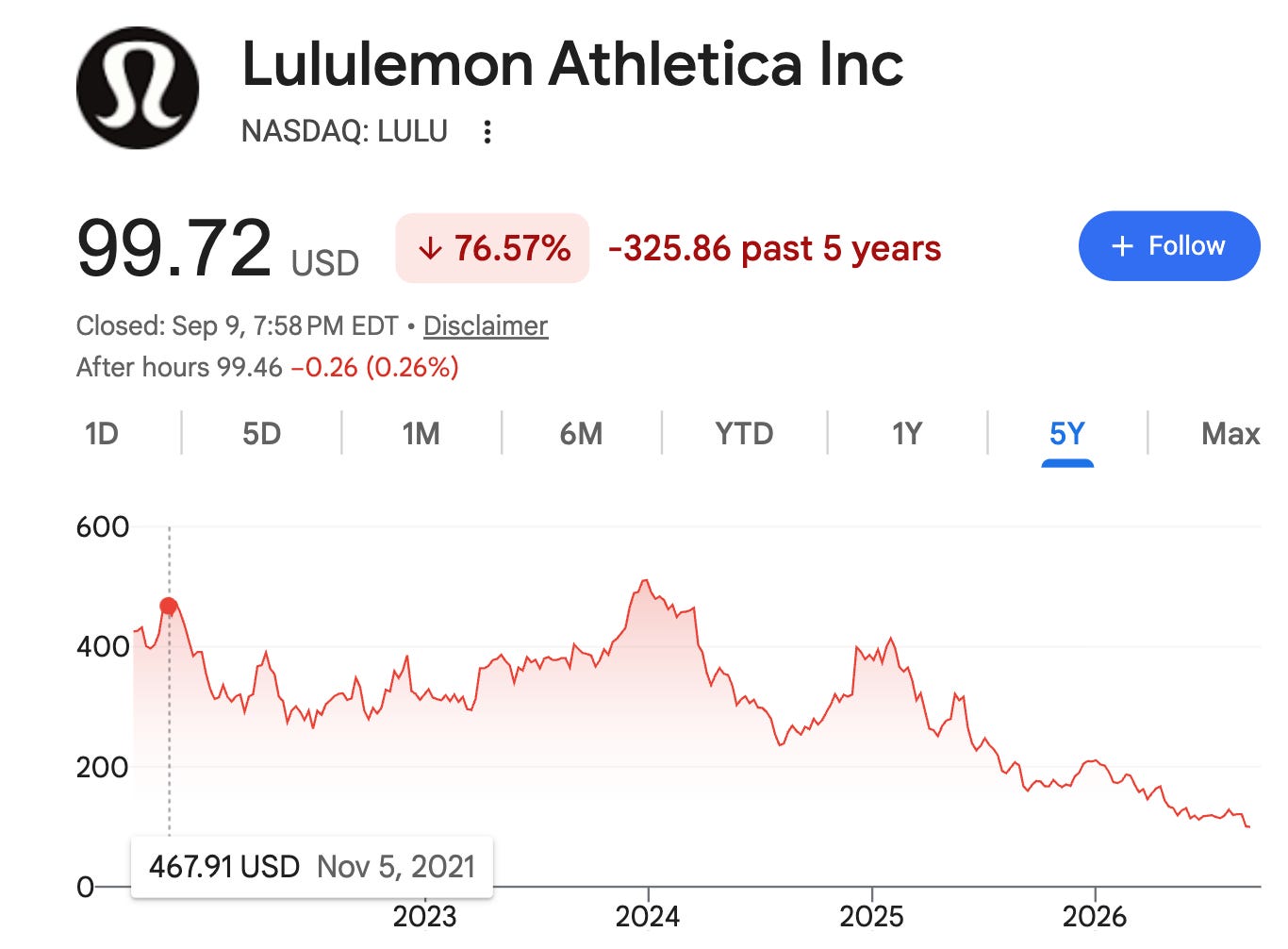
Revenue up and the stock down is not so unusual really. The stock price is about projected future growth and profits. And how fast that growth is. Is it accelerating? Slowing? What?
Lululemon grew the top line but lost the insane propulsive velocity, the straight up up up earnings trajectory and then, they lost the multiple investors were willing to pay.
By the numbers
Lulu’s latest full year was about $11.1 billion. That is a big number! A big business! To boot, their EBIT (operating profit) was 19.9% which is outstanding. Typical branded apparel sits at about 10-15%.
But the stock does not pay out for last year’s sales. It pays on future acceleration. Five years ago the market valued Lulu’s sales as if they would keep compounding at 20–40%. And they didn’t.
Annual growth went like this: +42%, +30%, +19%, +10%, +5% — and the current year is projected down 5–7%. So that’s the hitch.
An $11 billion retailer shrinking is worth less as far as the market is concerned than a $6 billion retailer that looks like it will be $20 billion.
Nike is an icon, Lulu is a brand
So there you have it on Lulu’s struggles. But given the noise around Nike dropping out of the S&P 100, there’s been much less attention on Lulu, comparatively. It makes sense. Lululemon is a strong brand. Nike is an icon. Of course the attention goes there. It’s just a bigger story.
Nike is a civic object: sneakers, athletes, China, wholesale versus direct-to-consumer, the question of whether the swoosh still owns cool. And then there is the “go woke go broke” narrative around Nike which is a sexy salacious story that makes for great headlines.
Every Nike miss becomes a massive culture story.
Lululemon, on the other hand, is a premium yoga-pants company that had a monster run and then lost its mojo. Which in some ways is inevitable. Ubiquity just isn’t as cool as scarcity. Managing growth when you are already everywhere is an entirely different business leadership challenge. So the acceleration slows as the brand becomes a staple and not a gotta-have-it-must-have new THING.
To be clear, the brand’s influence cannot be understated. They literally changed the way women dress. They made the black legging a weekend staple. And then an everything and everywhere staple. Maybe you don’t think that is a good thing, but it happened.
What we are seeing is a merchandising failure, not a national identity crisis. It’s a run of the mill business story.
The coverage of Lulu exists. It is boring earnings-and-guidance coverage. It is new leadership. But it is not a saga of epic business proportions.
They made leggings a thing that ladies want to wear. They didn’t change the way we think about exercise around the world. Nike’s vision — if you have a body you’re an athlete — inspired all of fitness culture (one could argue). Just do it inspired generations to dream big. To get out there and get it done. Their iconic ads — films really — changed the entire advertising industry.
Wearing leggings to lunch just doesn’t have the same impact.
And to be clear, Lulu’s business isn’t dead. It just lost the thing that justified a skyrocketing stock price.
The product got stale
Core women’s categories, especially leggings, fell hard — about 20 percent in the latest quarter. Their hero franchise styles sat too long without evolving while the market moved toward baggier, trendier activewear. Women moved toward wide leg sweats and Lulu stayed in leggings galore.
New launches were inconsistent. There were notable quality and fit misses.
That is fatal for a brand that sells $100-plus pants on the promise that they are worth the price.
Another factor, in my mind, which I’ve seen before a million times though no one talks about this — it became a kid/teen brand. Every middle schooler and high school girl wears it. And sorry, once that is the case, the coveted 18-34 age bracket doesn’t want it anymore. It becomes juvenile. It happened to Converse. And Gap.
The allure of growing market share by getting into the kids business is huge. But it can kill the core adult business if you don’t manage the growth. No adult wants to look like a twelve year old. Twenty maybe. Not twelve.
The competition was ready
Upstart rivals gobbled up the cool factor and filled the vacuum. Alo, Vuori, Free People and Skims stole the younger customer. Alo put forth a sexy super model vibe; Vuori went California cool; Free People has bohemian faux hippie feels and Skims . . . well, they have Kim Kardashian. They all felt new and for a woman who doesn’t want to see all her neighbors in the exact same outfit she is wearing, there were options. The products aren’t radically different but the brand vibes are.
Lululemon still has leggings, stores and a famous name. It just no longer owns the cultural slot it held from 2010 to 2023.
Geographies faltered
North America collapsed. America’s comp store sales have gone way negative, recently around -12%. That is the profit driver. And a measure of brand health. Are you able to grow the pie in the same territory or do you have to go seek new markets to grow?
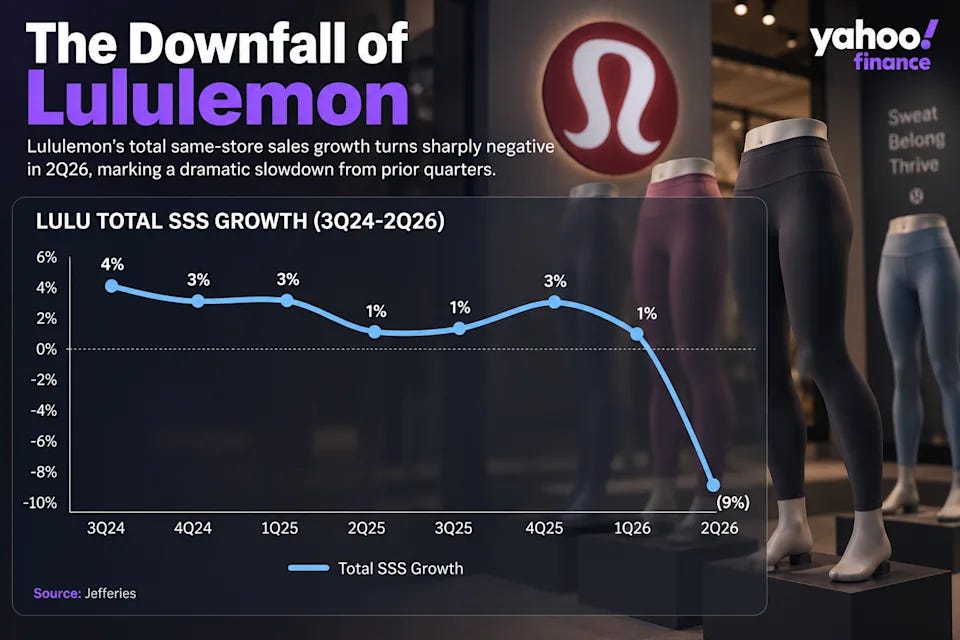
International used to obscure the weakness at home. But it doesn’t anymore. China, once the rescue story, also went negative after years of big growth (in this, there is consistency with Nike). A Great Wall campaign that used a Japanese taiko drum (do they not know the difference between China and Japan?) produced backlash and “negative commentary.”

That was not the only problem in China. But it was a self-inflicted injury in a market that has gotten more and more competitive in prioritizing its own home grown brands like Li Ning.
Leadership Chaos
Then came the boardroom. Founder Chip Wilson’s public war with the company, former CEO Calvin McDonald’s exit, interim co-CEOs up the wazoo, and a 6 months wait for a permanent chief head girl in the form of 26 year Nike veteran Heidi O’Neill. Investors really do hate a vacuum. And so do organizations. They spin. And spin.
Tariffs hit their Canada-to-U.S. model as well. And guidance was cut again and again. The trailing P/E ratio went from 60-70x in 2021 to 8-9x today. It went from on fire to meh in 5 years.
O’Neill started on Tuesday and the stock bumped up about 2%. Which can’t hold a candle to the -52% for the year so far.
She’s got a lot of work to do. She’ll be paid handsomely for it.
Base Salary: $1.4 million per year.
Target Bonus: 200% of her base salary.
Annual Equity Awards: Valued at approximately $10 million.
Sign-on/One-off Grants: Equity grants worth $7 million.
Retention Bonus: $2 million tied to a two-year service commitment
Fine. If she can turn it, why not? The question is, can she? Or will she recycle the failed Nike playbook that she deployed?
Current State
The sequence that markets punish is this: slower growth, negative comps in the home market, a diminished franchise product that the brand was once famous for, sharper competition, a broken China which was a huge growth story just a few years ago, and contested leadership.
AND . . . into that cluster-F walks Heidi O’Neill.
She is not a random outsider. She spent close to 30 years at Nike. She built Nike Women’s into a ginormous multi-billion-dollar business. She ran Nike Direct — stores, digital, apps — during the DTC acceleration phase. She became president of Consumer and Marketplace, overseeing $40 billion in revenues. That’s billion with a B Later she ran Product and Brand — the product engine plus marketing — until May 2025.
She was not Nike’s CEO during the decline. John Donahoe was. But she was his senior commercial operator in the years that matter as far as their down spiral. It would be hard to overstate her influence.
Reporting structures put O’Neill among the executives who supported and drove the aggressive wholesale exit in favor of DTC/retail. And this is how the business press wrote about her being put in the CEO role at Lulu — she was not just an executor but a key decision maker and driver of the failed strategy at Nike. There was a taint of the lady who drove Nike into the toilet is now being hired to lead Lululemon out of it? Seriously?
When Lululemon named her, the stock dropped about 12 percent in a day. Chip Wilson said a Nike veteran is not “transformative, creative-first leadership.”
Is Heidi that? Transformative? I don’t know. She’s an industry insider and talks a good game. I’m not surprised at all she landed the job. That’s how it works. Her resume says Nike. In a lot of big roles for many years. They don’t care what’s under the covers. They don’t care what the person actually did — only how they talk about what they did.
The hire has a major logic problem. Lululemon’s crisis is product innovation and relevance, North America comps, and brand cool. This is exactly what has been drained from Nike in the last 5 years, while O’Neill over saw all of it.
Nike itself is walking back the DTC channel transformation O’Neill helped run, and crawling back to wholesale partners that they’d cast aside in a snobby fit. Hiring the person most identified with that era reads like more of the same.
But maybe she’ll surprise us.
She may still fix the basics. The assortment and speed to market. Store operations. There isn’t much “brand” to speak of other than high priced yoga pants worn mostly for other soccer mom activities like school drop off. I mean, what does the brand stand for? And can she give it meaning?
Apparel brands rarely die in a blaze or a scandal. They die when the customer quietly chooses someone else’s pants. I lived that at Levi’s. And we brought it back. It is possible. But you don’t get to stay there automatically even if you do bring it back. You have to keep pushing out new innovative stuff and new ways to be relevant.
The question is will O’Neill put the same Nike playbook into the system — the playbook that dropped Nike’s stock almost 80% in 5 years? Does she know another playbook? Can she figure out exactly what the brand needs?
We shall see. I truly have no idea.
Lululemon supports transgender cult ideology.
Lgbtq Pride Clothing | lululemon https://shop.lululemon.com/a/lgbtq-pride-clothing-0sfz11a
My head hurts after reading all that!
From “Just an old guy who wants to look OK”
Keep up the good work Jenn!!!