

After 18 years in the S&P 100, Nike is out. Nike will officially be removed from the prestigious S&P 100 before the market opens on September 21, 2026. The index tracks the largest and most stable mega cap companies in the U.S. While Nike is still large, it is no longer stable. The expulsion follows a severe stock decline, where Nike lost close to 80% of its market capitalization in the last 5 years.
As for the Fortune 100, Nike held on but only by a thread. They entered the elite fray in 2016 at number 91. The brand peaked in 2022 at number 83. It’s been a steady decline ever since. And this year, the brand barely hung on at number 99.
From their stock price high in 2021, the brand has tumbled about 78 percent.
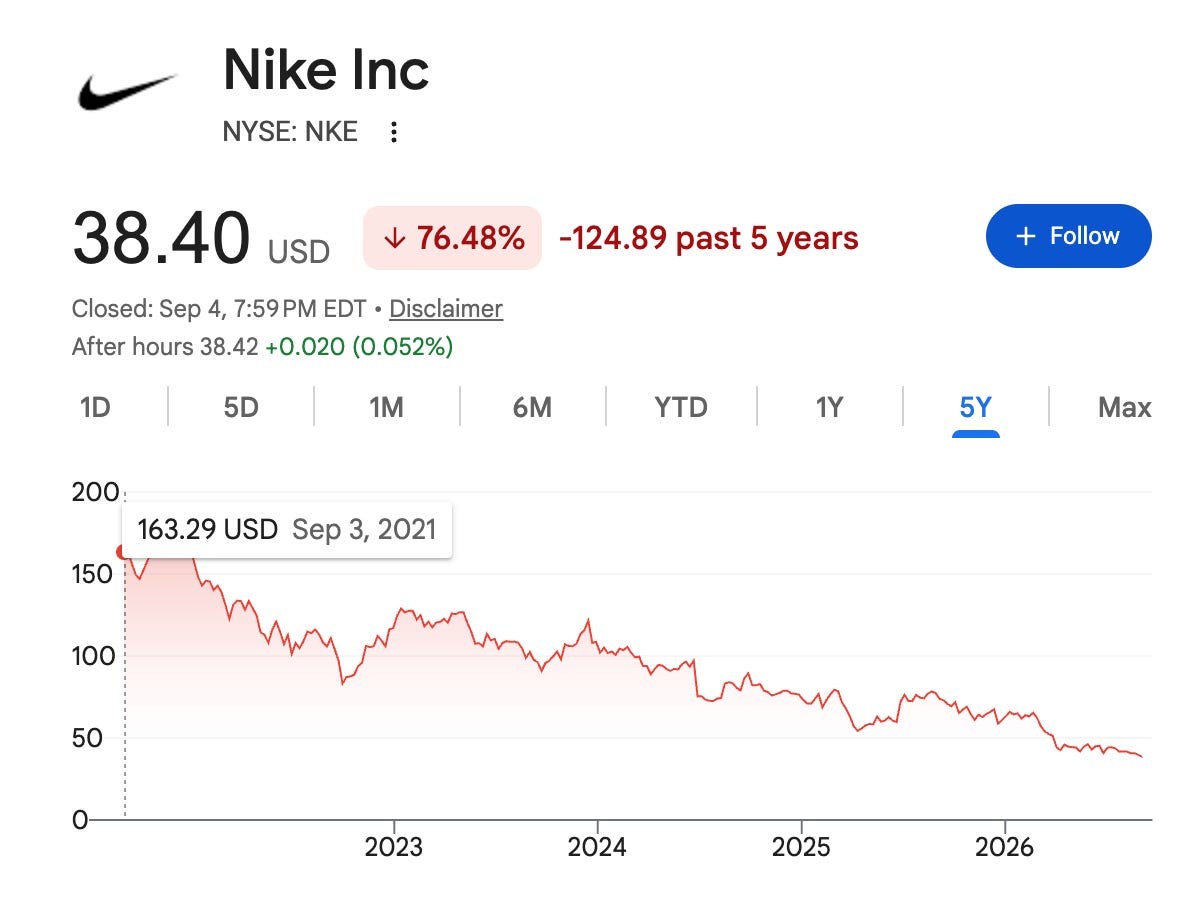
The company that spent nearly 2 decades inside the elite S&P 100 now sits outside of it, with fiscal 2026 revenue of $46.4 billion — still the biggest athletic brand on earth, by a long shot. Adidas is number 2 at a little more than half of Nike’s revenue. But the brand that could do no wrong is no longer the behemoth admired by all.
The climb took decades. But the fall has been swift.
In fact, their peak revenue year was just 2 years ago, in 2024 at $51.36B. They’ve lost about 5B in revenue since then, or 10% in just 2 years. But the signs were there even when they were still growing; alarms were already being sounded about weakening economic fundamentals, even at the brand’s highest revenue moment.
I’m going to nerd out for a second, skip ahead if you don’t want to read about gross margins . . .
Declining Margins
Ok . . . while Nike’s gross margin for the full year of 2024 technically ticked up to 44.6%, it was due to lower freight costs — not brand strength or pricing power. Basically they lucked out with the lower freight costs, and kicked the can down the road. But not for long. The signs of margin erosion were already there. This is a critical metric in retail indicating brand health. And Nike Direct (their own stores and ecommerce site) margins were already actively declining, and this would ultimately impact the entire business.
The erosion of margin was due to an inventory glut (they made too much product, more than people wanted to buy) which lead to the need to heavily discount that product, which creates an endless cycle of doom in retail. Bad for business and the brand. And Nike knew it.
Lack of product innovation
But the most prominent talk of weakness was rooted in the lack of product innovation which had been their leadership bread and butter for decades. Corporate leadership had become over-indexed on financial optimization, digital metrics and recycling old franchise product (like AF 1s and Jordans) rather than creating new innovative performance and running shoes. (Their lunch in running was already starting to be eaten by Hoka and On Running.) The brand got boring.
So even though 2024 appeared to be a banner year on the top line, the cracks were already there.
And by the summer of 2024, the reality of these cracks culminated in a disastrous annual earnings report (their fiscal year ends in May), triggering a historic 19% single-day stock crash in July 2024 (they lost $28B in market cap in one day) which ultimately led to the ousting of CEO John Donahoe, who hailed from EBay, later that year. (Hence the obsession with digital optimization rather than brand building.)
The envy of all
For decades Nike was the apparel brand that every fashion and clothing brand envied, admired and emulated. And just when you thought they couldn’t get better at being Nike, they did. No one could capture their magic. It defied the odds to just keep growing and getting cooler when already huge and exceedingly cool. Their product innovation, their branding know how, their athlete/influencer dominance — everyone envied it in the industry. Everyone hoped for just a taste of it.
That era ended in a pile of unforced errors.
Mistakes were made
Nike pulled out of mainstream wholesale — Amazon, DSW, and a long list of the places regular people actually buy sneakers — so it could chase a more expensive, higher-margin direct-to-consumer (DTC) business and a customer it preferred: richer, more “progressive” and political, less “normie.”
It overproduced what used to be limited edition drops (“collabs”) and wrecked the scarcity model that had made those products feel so cool for years.
It leaned too hard on China and watched that market grind lower, quarter after quarter.
The cultural piece is real — “go woke go broke” — but it is not the whole story.
The taint started before the full-bore politics. Former star CEO Mark Parker’s later years included the Allyson Felix pregnancy scandal, the Mary Cain abuse revelations out of the Oregon Project, and the shutdown of that training club. Those episodes were not “woke.” They were the opposite, in fact. Firing pregnant ladies and abusing teenaged girls?! Please.
Then the company went all in on woke leftist politics: Kaepernick, covid advertising, and Dylan Mulvaney as brand ambassador. Phil Knight retired as Chairman Emeritus in 2016. Maybe that was the nail in the coffin. Maybe that’s when common sense and leadership left the campus. Who knows.
But by 2020, Michael Jordan’s old warning — “Republicans buy sneakers too” — was treated as an old and outmoded way of thinking. The brand wanted the rich woke-sters and everyone else could F off. What did this achieve? Well, it got them a smaller, angrier customer base and a stock price in the toilet.
And now . . .
They are trying to walk some of it back. Sorority rush-week sponsorships and a quieter culture war are not a strategy. Elliott Hill, the lifer pulled out of retirement to lead Nike back from the doldrums, took over in October 2024.
But a new CEO cannot wave a magic wand to solve over a decade of distribution mistakes, inventory gluts and core customer alienation. He is already under pressure. And he might not last long. Questions about how long he should get to drive a turn around are everywhere. On August 31, Fortune asked the question:
“Nearly two years after Elliott Hill returned to Nike as CEO, his tenure raises a question that eventually confronts almost every leader handed a struggling business. How much time should someone get to prove that a turnaround is working?”
This thrashing is larger than “go woke, go broke,” even if that is a large part of it. It is what happens when an iconic company decides the people who built it are the wrong customers; when it decides new customers would be better and to hell with the old ones; when it decides that the customer no longer comes first rather a political ideology combined with a vision for the business that leaves too many existing customers out.
My former place of employ Levi’s could be considered the cautionary tale. Sales for the jeans behemoth peaked at $7.1 billion in 1996 and then bottomed out at $4.07B in 2004.
Levi’s recovered — somewhat. The brand went public in 2019 with a successful IPO and revenue of $5.76 that year. But the brand has never gotten back to its height of $7.1B.
And now, after years of middling performance, the company still hovers around $6 billion — never again the force it was, no matter how many comebacks it announces.
Is Nike the new Levi’s? Who knows. Nike will always exist and probably always capture significant market share.
But . . . my prediction: it will never again be the dominant, untouchable brand it was for nearly 40 years.
Some declines you don’t reverse. You just live with a smaller version of what you used to be.
Go Woke Go Broke is a symptom, not causal. A Marketing Department with no adults and no diversity of thought. Corporate leadership out of touch with reality. Sad to watch this happen. Often to companies that lose sight of how they got success in the first place. And arrogance sets in.
I was done with Nike when information was coming out about them using slave labor in China. The more that came out about the abuses against the Uyghur's was just appalling. The NBA also was under scrutiny as well for producing some of their merchandise from them. These poor people need to be freed from their oppressors. It is just so sad.