

RushTok is the annual August spectacle of sorority recruitment on TikTok: outfit-of-the-day videos, house tours, sorority row tours, philanthropy rounds and Bid Day sprints.
All this sorority stuff always happened but it became a viral social media thing around 2021.
I should mention — I was not in a sorority in college. In fact, I hated everything having to do with sororities. I was a snob, of sorts. I was “alternative.” I had a nose ring and dyed black hair. I made fun of people who rushed and were sad when they didn’t get in to the one that they wanted. Why would you want to be in a group that hazed you? And then give them the power to decide if you were good enough to be in their club? I was sullen and that was my thing and I rejected cheerful sunny types in sororities. I thought the whole thing was stupid, and I still kind of do but I also appreciate that these girls are having fun. And why not have fun in college? Why not always have fun as much as possible?
Still, the part I think is the most silly is wanting to be accepted into a club. Any club. I don’t really do clubs. What makes one better than another? Why is someone happy to be a Tri Delt but less happy to be a Pi Phi . . . or whatever the letters are? They all seem the same to me.
I was a certain kind of stereotype too, but it had to be done. After years of obedience in gymnastics, I needed to adopt the stance of a rebel. Even if I wasn’t actually very rebellious. I was a little rebellious. But I didn’t really embrace it until I was old. Like old old. Like now old. And by rebellious I mean willing to truly stand apart, not in a superficial way. Like stand apart and have everyone actually kind of hate you. I wasn’t ok doing that until I was ~40 but I guess I practiced in college with my faux rebel thing.
Back to RushTok.
It exploded in 2021 when University of Alabama freshmen started documenting Bama Rush. The videos were stylish, competitive and strangely addictive — even for me, a committed anti-sorority person.
The hashtag spread to other Southern campuses and never left. Alabama, South Carolina, Texas, Georgia, Tennessee — the SEC and Big 12 houses became appointment viewing. You could scroll and scroll and watch hordes of indistinguishable girls dancing on Greek Revival porches in coordinated looks. Happy. Put-together. Not lecturing anyone. Blonde. Very blonde.
I have a new appreciation for this. It seems being a normie sorority girl is the rebel thing to do now, in a sense. Embrace life. Don’t be miserable. Don’t hate on everything.
Here is what the videos are like. There are gazillions. It’s hard to pick just one to show you what these are like.

 Tiktok failed to load.
Enable 3rd party cookies or use another browser
So . . . after about 5 years of hot dancing sorority girls on TikTok and Instagram, this year Nike showed up.
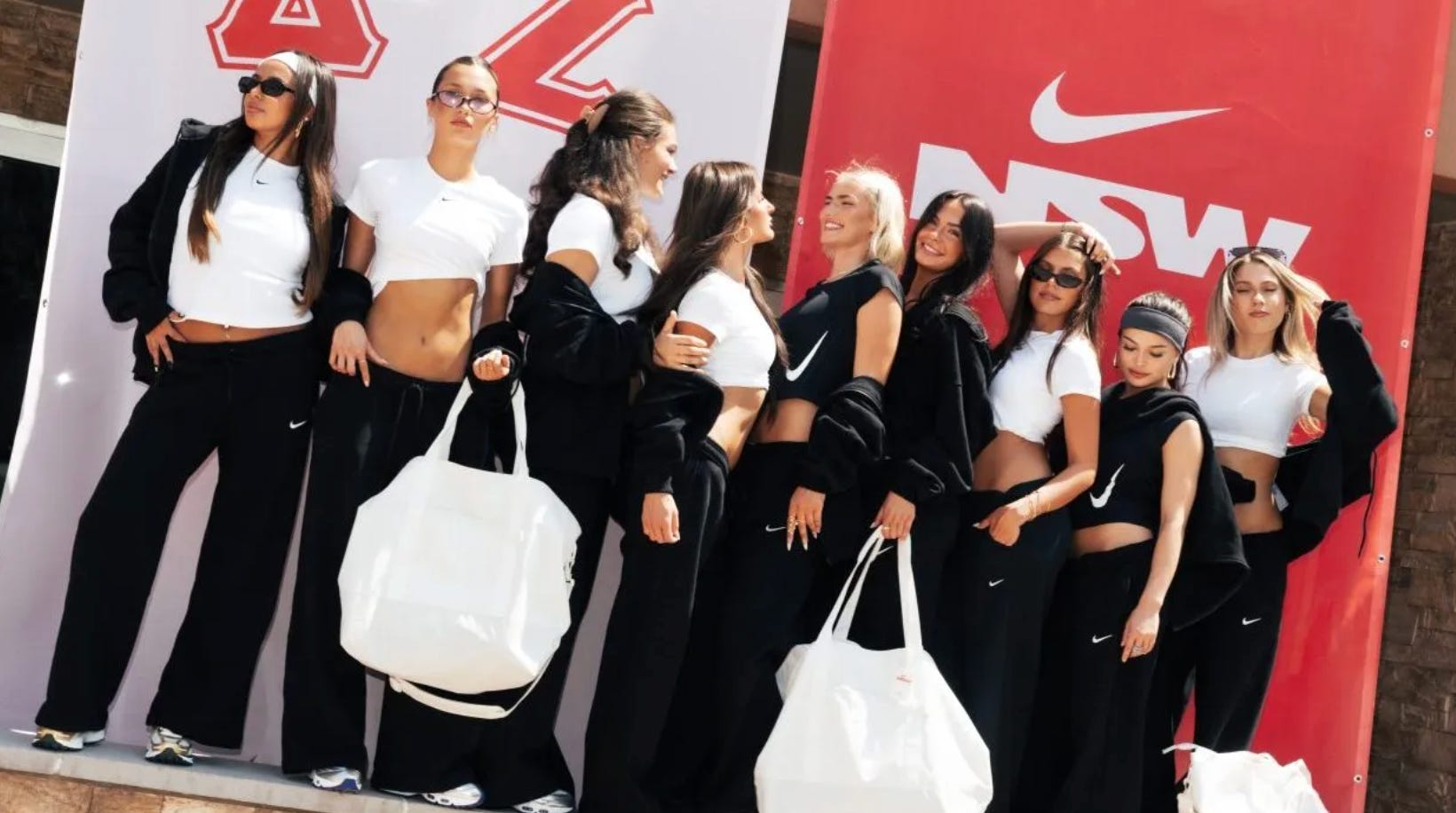
For the first time the company formally sponsored rush of at least six chapters, including South Carolina, Texas, Alabama and Arizona State. Here’s what that looks like:
And here’s another “behind the scenes of rush” Nike vid, this one from University of Alabama, hash-tagged #bamarush.
The brand sent training, running and sportswear gear. It parked customization trailers out front. It unfurled giant Nike banners across columned houses. Sorority sisters wore the product in dancing videos that drove millions of views.
Nike’s college business director called the women “campus athletes.” Some of them are athletes. Some are not. They are all fit. In these videos they are mostly hot girls dancing during rush. The are blonde (mostly) — definitely no blue hair, lean, sporting low-rise sweats and washboard abs; they are Southern (for the most part, these are the schools targeted) and they are having fun.
No politics. No lectures. No dour serious faces. No kneeling. No protesting. No talk of grievances of any sort.
Just Pi Phis and and Tri Delts and hot girl summer. Which, let’s face it, is right coded. No politics? Blonde hair flying? Please. They are conservatives. Or, at the very least, they aren’t woke.
Nike spent years featuring elite, usually politically aligned athletes and courting the cultural left. We got lectured for being bigots if we thought Caster Semenya was too masculine (he’s a man); Kaepernick was championed for kneeling during the national anthem; and Dylan Mulvaney was featured in a running bra. If you didn’t like it, tough. You could leave.
Nike told us what to think. The brand didn’t seem to care if that excluded half of America. And frankly, Americans didn’t care. They (mostly) kept buying the brand outside of a few, not very long lasting shoe burning protests.
Nike has been the dominant player in athletic shoes and clothing for about 50 years. In 1980, Nike had over 50% of the athletic shoe market. At their height, the brand commanded 96% of the basketball shoe market! That is insane.
Their financial performance and market share has dwindled in the past 5 years due to poor leadership, questionable choices around distribution (they abandoned key wholesalers in favor of “DTC” — direct to consumer selling in their own stores and their own on-line store), a stumbling China market and a bunch more reasons which certainly include “woke-ness” which really means leaving half of the country out of their targeting and creative efforts.
The brand took its eye off of the athletic performance ball, and let upstarts like On and Hoka eat their running shoe lunch. They got so focused on fashion they forgot to compete in performance. Their market share now rests at about 22% and their stock price has tumbled from a height of ~$177 in November 2021 to a persistent low this year in the $39 zone, a fall of close to 80%. Staggering.
I will tell you from being in the industry — Nike was it. Every brand strived to be as dominant. The brand bucked common knowledge which said you couldn’t be the biggest and the coolest but they were. A brand could be cool and niche, or giant and meh. But Nike was BOTH super cool and completely dominant. For decades. Everyone wanted the Nike special sauce.
Every time you thought they couldn’t do it again — release a better shoe, contract a better athlete, do a cooler collab drop or make a more iconic ad . . . they did it. It seemed they could do no wrong. For decades.
Until . . . they could do no right.
Now every board meeting and quarterly performance report features turn around talk. And every subsequent quarter features the ongoing decline and the announcement of a new leader who will be the difference maker.
For decades Nike had a secret. They marketed cool but sold to normies. Outlet stores were the dirty little secret and most profitable direct to consumer channel; old folks bought lame sneakers at Kohl’s or other uncool places for mall walks; and yes . . . young women in Texas and South Carolina loved and wore the brand.
These sorority “girlies” were not featured in the brand’s imagery. They weren’t even courted in the marketing. They were tolerated. And, look, it is not at all unusual to feature a certain look and feel (edgy) while knowing the “consumer target” is entirely different. Broader. Bigger. Blonder. Less “cool” in an urban, citified, and yes — leftie sense.
But then . . . Nike began to overtly disrespect the broader target that made them huge. And that’s when things went south. Not literally. Figuratively.
Now they are actually going South, to bring back some of the glory . . .
With this latest sorority play, Nike is leaning hard into the most normal demographic in America and pretending this is continuous with everything that came before. Or at least ignoring that it is an about face. These are not the faces Nike put on its biggest campaigns in the past. They are the customers Nike left behind while it chased cool and woke virtue.
It is clear why the company is suddenly interested in normies. Nike stock now trades around $39 — roughly a quarter of its peak. It’s been one fail after the other. The DTC-first distribution bet alienated wholesale partners and left inventory rotting. The China business went from rocket ship growth engine to eight straight quarters of decline against nimbler local and premium rivals. Over-produced “limited” collabs stopped feeling limited and stopped being cool. And this all drove an overall loss of the “it” factor.
Of course conservatives like to say Nike went woke and then went broke. And the brand had a long stretch of cultural signaling that treated a huge share of customers as an afterthought.
I’d always said it wasn’t just that. And it wasn’t.
But their latest play for normie cool girls seems to say without saying it — yes, that was a huge part of the problem.
The sorority play looks like an admission that they left the middle of the country behind. What is more normal than Texas and South Carolina rush girls? These girls are not constantly cataloguing what ails the world. They aren’t piercing their faces and bemoaning the fate of things. They aren’t crying about climate, or claiming untold numbers of gender and sexual identities. They are having fun. They are straight. They don’t use pronouns. Some of them are almost definitely Republicans or future Republicans. They don’t protest every weekend, they date and drink at parties. They may or may not vote.
Needless to say, these were not my people in college. But if I could go back and choose now, I think I’d lean towards fun rather than hostile and depressed as my chosen personality type.
Michael Jordan already said it: Republicans buy sneakers too. And in today’s world, that means normies. Who are, in some sense, the rebels in a world where mainstream institutions still prioritize wokeness.
Nike may have finally noticed. It dug itself into a hole for years.
Sales are still down, though it is still the biggest athletic brand — by a long shot.
Nevertheless, the stock keeps sinking because if you aren’t growing, you’re dying in the world of Wall Street. There is talk of replacing the current CEO, Elliott Hill — who only started in the role in October 2024.
The road back will be long, and it probably does not lead to the share and cultural dominance of the past. But any road back includes respecting the full, broad and culturally diverse consumer base.
The banners on the rush houses are a start.
Thank you so much for this. I think you nailed what many of us who run companies have been thinking about as we viewed Nike perpetually tripping over their laces.
With you on Sororities and Fraternities. As the saying goes: "I would never want to be a member of any club that would accept me". (Paraphrased)
As a fraternity guy who rushed his freshman year to the fraternity his father pledged, I was a "legacy" and so did not need to deal with the fear of failure. Rush can be a nasty process for girls or guys with low self-esteem. But once in the Greek system, I can say with great confidence it was a LOT of fun, for me, my bros, and the sorority girls we partied with (sometimes multiple times a week, including breakfast mimosas and screwdrivers). Maybe too much fun. I was a terrible student my first three years in college because I put my social life in front of my academic life. I was a very good partier. If that is your thing, like it was for me before 21, then Greek life is for you. But if you really want to get a great education and maximize your academic experience, steer clear. I transferred after my junior year, with sophomore credits, and became a very good student outside the college party system